Wednesday, March 20, 2013

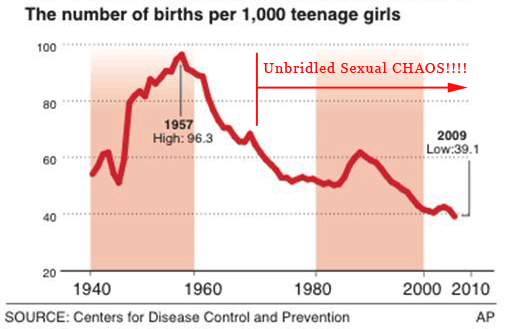
PZ Myers on teenage births

For a refreshing reminder of the mendacity of the cultural left, look no further than PZ Myers' recent post on the consequences of the sexual revolution.

Myers takes umbrage at a "militant Catholic" (Patrick Fagan of the Family Research Council), who observes:

Having set chaos in motion... , the Supreme Court quickly built the garbage bin for dumping sexual debris in Roe v. Wade, which gave a green light to the killing of 55 million unborn children, the overwhelming majority of whom were conceived by those unmarried singles with new access to contraceptives.

Myers demurs. He insists:
It didn’t happen. 
Also, I’ve got to wonder if the author thought his thesis through. New access to contraception led to a surge in unwanted pregnancies? Only if they weren’t doing it right. 
Maybe we should have coupled contraception access to better sex education. 
Or just maybe the chaos was all in the author’s head.


Hmmm. Why did Myers pick teenage births, rather than, say, teenage pregnancies?

Something's odd. So how to explain Myers' graph?

First of all, marriage rates were higher pre-1960, and people married considerably younger than they do today. The spike from 1945 to 1960 is the Baby Boom. A 19 year old married woman having a child by her husband (not an uncommon event in 1955) would show up on the graph. That is not the same kind of "teenage birth" one commonly encounters in 2013, which is nearly always an unmarried teen girl who commonly doesn't even know which of her 'hook-ups' is the father.

Second, no one in their right mind thinks that teenage pregnancies declined in frequency with the sexual revolution.

Here's the graph that Myers didn't show:

Rates per 1000 women aged 15-19.


The dark blue line corresponds roughly to Myers' graph. The yellow and magenta lines correspond to the pregnancy rate and the abortion rate, respectively. The reason that the teen birth rate dropped wasn't that the teen pregnancy rate dropped; in fact, the teen pregnancy rate skyrocketed. The teen birth rate dropped because following the sexual revolution the teen abortion rate skyrocketed even more than the teen pregnancy rate.

:0

So how could we summarize the data presented in the graph of teen birth, abortion, and pregnancy rates?

"[A] garbage bin for dumping sexual debris in Roe v. Wade, which gave a green light to the killing of 55 million unborn children"

nails it.

These militant Catholics always get it right.

PZ Myers selected the one graph out of three that didn't directly contradict his point. He chose not to post the other two graphs explaining the drop in teen births-- the graphs that showed the explosion in teen pregnancy rates and the even larger explosion in teen abortion rates that accounted for the drop in birth rates.

Myers lies like he breathes. 

Tuesday, March 19, 2013

"What do you think of Obama pardoning the sequester and sending it to Portugal?"

Jimmy Kimmel asks passersby on Hollywood Boulevard what they think of President Obama's "decision to pardon the sequester and send it to Portugal."


At least the last lady was honest. 

Monday, March 18, 2013

330,000,000 abortions

Putting a number on China's holocaust:

Data reveal scale of China abortions 
By Simon Rabinovitch in Beijing

Chinese doctors have performed more than 330m abortions since the government implemented a controversial family planning policy 40 years ago, according to official data from the health ministry. 
China’s one-child policy has been the subject of a heated debate about its economic consequences as the population ages. Forced abortions and sterilisations have also been criticised by human rights campaigners such as Chen Guangcheng, the blind legal activist who sought refuge at the US embassy in Beijing last year. 
China first introduced measures to limit the size of the population in 1971, encouraging couples to have fewer children. The one-child rule, with exceptions for ethnic minorities and some rural families, was implemented at the end of the decade.

Since 1971, doctors have performed 336m abortions and 196m sterilisations, the data reveal. They have also inserted 403m intrauterine devices, a normal birth control procedure in the west but one that local officials often force on women in China.

Please read the whole thing.

Please note that very few of these hundreds of millions of abortions and sterilizations should be considered voluntary in any sense. The legal pressures to comply with the law are immense. And, of course, none are voluntary from the perspective of the child.

Note as well that 100 million of these abortions (and infanticides)  are selectively against girls, creating the worst femicide in human history.

Abortion-mongers tout abortion as a matter of "women's rights". Yet abortion is the most prolific killer of girls in the world today-- 200 million girls slaughtered in China alone, along with 100 million little boys.

China's One-Child Policy, and other population control policies, is our modern holocaust, like the one in Europe in the 1940's, only much much larger.

Sunday, March 17, 2013

Happy St. Patrick's Day!


Philip Jenkins has a great post on the real St. Patrick, and the evil that he confronted in his mission.

Excerpt:
Among the many millions who celebrate Irishness every March 17, scarcely any wonder for a second whether there is any historical substance to the figure of St. Patrick, any more than to a host of other medieval wonderworkers. Treating such a tale as serious history, they assume, makes about as much sense as writing a critical biography of the Easter Bunny. 
Sadly, such indifference means that moderns are missing a story that is not just rock-solid history, but is one of the most moving in early Christianity...

Please read the whole thing. It's fascinating history.

Happy St. Patrick's Day! 

Saturday, March 16, 2013

"What if the Pope was one of us..."


This photo of Cardinal Jorge Mario Bergoglio-- Pope Francis-- riding the subway to work in Buenos Aires in 2008 reminds me of Joan Osborne's song "One of Us".


"... just a stranger on a bus trying to make his way home..."

Friday, March 15, 2013

"Rise up and walk"


Walter Russel Mead has a deep insight into the election of Pope Francis to the throne of St. Peter:

G.K. Chesterton tells the story of the time that St. Francis of Assisi visited Rome and the pope of the day proudly showed him all the wondrous treasures of the Vatican. Referring to a story in the Biblical Book of Acts in which St. Peter spoke with a beggar in Jerusalem and told him he had no money, the pope pointed to the treasures around him and said, “Peter can no longer say ‘Silver and gold have I none.’” 
St. Francis’ response: “Neither can he say, ‘Rise up and walk.’” 
... St. Francis’ point was that the triumphal, institutional church of his day was prestigious and wealthy, but it had lost the inner fire and dedication that made Christianity a world-transforming faith. 
So now we have a Pope Francis, and we are about to see what he can make of the papacy, and whether the Catholic Church in his day will be able to rise up like the beggar and walk. In some ways, Francis was a typically canny choice by the oldest electoral college in the world.

The Church is a worldly institution, as well as a Spiritual Body, and it needs silver and gold to carry out its ordained mission. But perhaps we need a bit more of St. Francis-- a bit more radical sacrifice and love for the poor, a bit more self-abnegation, a bit more humility. The Church already has these charisms in spades-- more than any human organization. But perhaps we need to do even more, in the footsteps of St. Francis.

Mead:
[W]hat we know of [Pope] Francis’s ministry in Argentina suggests that he knows that in Christianity doctrine, important as it may be, is not the heart of the matter. Christianity at the end of the day is about God’s all-forgiving, all-embracing, illimitable love. Love is the chocolate, doctrine is the box and the point of the doctrine is to protect the chocolate and keep it fresh for use, not to separate people from the feast God wants us to share. 
[Pope] Francis famously attacked, for example, the practice of some Argentinian priests who put obstacles in the path of single mothers seeking to baptize their kids. The then Cardinal Bergoglio’s response was pretty much what one suspects Jesus himself would say. As the Telegraph reports:

“In our ecclesiastical region there are priests who don’t baptise the children of single mothers because they weren’t conceived in the sanctity of marriage,” Cardinal Bergoglio told worshippers last year. 
“These are today’s hypocrites. Those who clericalize the Church. Those who separate the people of God from salvation. And this poor girl who, rather than returning the child to sender, had the courage to carry it into the world, must wander from parish to parish so that it’s baptised!” 
Recognizing a young unwed mother as a moral hero because she doesn’t get an abortion won’t win Francis many points with those who think there can’t be too many abortions (especially among the poor) in this wonderful world of ours, but this is the kind of perspective the Catholic Church, and indeed any human community, badly needs. And if one consequence is that more pregnant young women find networks of support and solidarity as they choose to bring new life into the world, [this blogger] for one will think an important corner has been turned.

A Pope who will turn the Church even more to the ways of St. Francis may well be the blessing for which we have prayed.

Thursday, March 14, 2013

Consciousness unexplained


I find it difficult to write about Daniel Dennett.

Dennett, in case you have not had the opportunity to get to know his work, is a philosopher from Tufts University. Dennett is an atheist, and is one of the Four Horsemen of New Atheism-- along with Richard Dawkins, Sam Harris, and Christopher Hitchens.

Dennett's primary interest in philosophy is philosophy of the mind. He has written several books on the mind, including Consciousness Explained and The Intentional Stance.

So why do I find it so hard to write about Dennett? He is perhaps the most evasive and incoherent philosopher I have read. He rambles endlessly, and just as endlessly delights in bizarre conceptual constructs that serve only to obscure the topics he feigns to investigate. He is perhaps the most shameless sophist I have encountered, although Hume would give him a run.

Dennett, as you might imagine, is enamored of Darwin (he famously described Darwinism as "the best idea anybody ever had"), and his philosophy of mind is strictly materialist, to the extent that it is strictly coherent, which I will allow only for the purpose of discussing it.

He utterly denies the reality of qualia, which is the subjective experience of a sensation-- the "what it is like" to experience something. The feel of pain, the smell of coffee, the sight of red are each a quale. Qualia are notoriously difficult to explain materialistically. How can meat (the brain) "feel" anything. We can explain input, output, processing, behavior using material concepts of synapses and neurons, but how can we explain how it is that we feel something. No part of materialist science is subjective. Materialist science is objective, and seems incapable of explaining subjective experience. Dennett dismisses qualia rather abruptly as incoherent concepts, not really amenable or even worth philosophical investigation. This of course is convenient for a materialist, because it removes a huge philosophical obstacle to the materialist explanation for the mind. If qualia aren't real, that makes a materialist philosopher's job a lot easier.
Yet Dennett's dismissal of qualia, like Dennett, can't be taken too seriously.

Dennett still asks for novocain at the dentist, presumably.

Dennett takes the second bugbear of materialist philosophy of the mind just a little more seriously. Intentionality is the property of the mind that refers to the "aboutness" of a thought. Material things are, of course, themselves (philosophers love to say things like that), but they are not inherently "about" anything. Imagine an uninhabited world, with a seashore. Imagine that the waves arranged a few of the pebbles on the seashore in the shape of the word "Hi". If there were no minds in this uninhabited world, the rocks arranged as "Hi" wouldn't be "about" anything. They wouldn't mean anything. They would have no intentionality.

But in an inhabited world, rocks arranged as words might mean something, depending on the agent that arranged them. Perhaps it was a greeting made by a child playing on the beach before you arrived. Perhaps the arrangement was made by a mind.

In traditional terminology, intentionality is the mark of the mental. I've discussed intentionality in much more detail here.

Dennett's materialistic explanation for intentionality is, like his oeuvre, muddled, and he managed to get an entire book out of the muddle.

Succinctly, Dennett believes (of course) that intentionality can be explained in entirely materialist terms. He proposes that we assess things in our experience in terms of "stances", which are assumptions we make about them based on our experiences with them and on our survival needs vis a vi them. We assess inanimate objects via a physical stance, we assess designed objects via a designed stance, and we assess living things via an intentional stance, in which we attribute meaning and predictability to its behavior.

Although Dennett seems to believe that he has gone a long way to explain intentionality using materialist presuppositions, it should be fairly obvious that such hand-waving does nothing to explain how it is that a physical system-- a brain for instance-- could generate the "aboutness" that is the hallmark of the mind.

Dennett explains his agenda surprisingly candidly in Consciousness Explained:

"My fundamental strategy has always been the same: first, to develop an account of content that is independent of and more fundamental than consciousness-- an account of content that treats equally of all unconscious content-fixation (in brains, in computers, in evolution's recognition of properties of selected designs)-- ad second, to build an account of consciousness on that foundations.  First content, then consciousness. "(1)
Dennett evades the fundamental problem with the materialist explanation for intentionality by conjuring analogies between the mind and computers and natural selection. Yet he evades the obvious: materialism shipwrecks on intentionality. Matter provides no meaning without mind. So how can mind be mere matter?

The intentionality conundrum is solved, in my view, only by hylemorphism, which is the traditional Aristotelian view of nature as comprised of substances, which are themselves composites of matter and form. Form is the intelligible principle of a thing, and the "aboutness" of a thought is the consequence of the incorporation of the form of the thing into the mind, which is itself a form.

Hylemorphism avoids the banality of materialism and its intrinsic inability to explain the fundamental properties of the mind. It provides a natural explanation for intentionality. A concept related to hylemorphism, essentialism, provides a natural explanation for qualia as well.

I'll try to post more about Dennett when I can. Perhaps for Lent, as part of my penance.

I met Dennett at a seminar a few years ago, a story worth telling, soon.

(1) 1991, Back Bay Books, Little Brown p457